SEO / GEO / AEO / Vercel / Non-WordPress
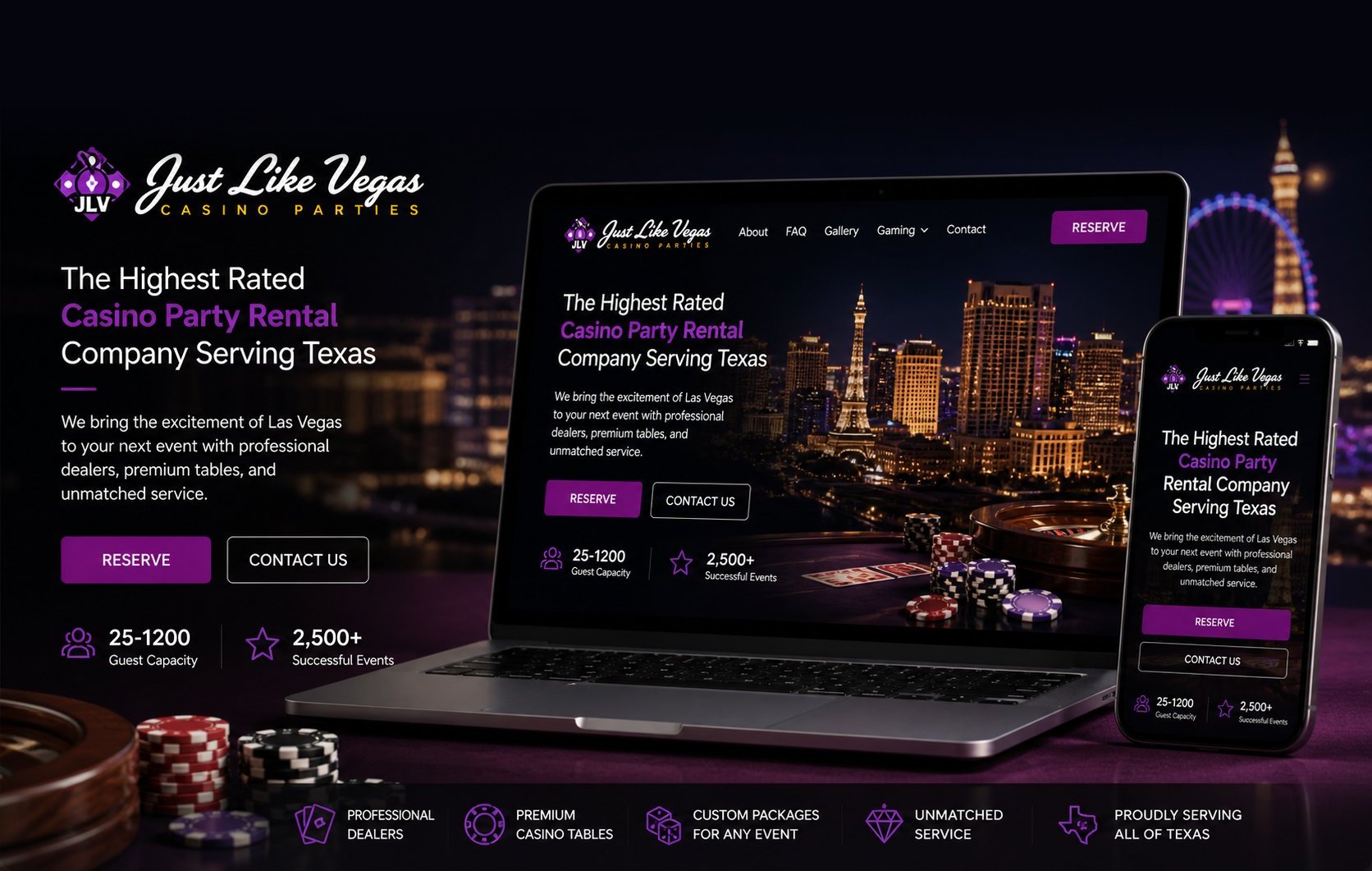
A platform-agnostic SEO overhaul covering technical cleanup, canonical fixes, structured data implementation, and a full GEO and AEO strategy for a competitive entertainment market.
The site worked. The business was delivering. The problem was that almost no one was finding it through search — despite operating in a market with strong organic demand and almost no technical reason to be invisible.
This engagement started as an SEO audit and became something more comprehensive: a full visibility strategy spanning traditional search, AI-generated answers, and voice queries. The work was done entirely on a non-WordPress, Vercel-deployed stack — which is the point worth examining just as carefully as the results.
The Challenge
Just Like Vegas had invested in a professional website built on a modern JavaScript stack deployed through Vercel. The site looked premium and performed well for visitors who reached it. But the technical layer underneath — the signals Google, AI tools, and voice assistants rely on to understand, index, and recommend a business — had accumulated problems working against the business invisibly.
Canonical fragmentation meant multiple URL variations of the same page were competing against each other rather than consolidating authority to one canonical document. Redirect chains were diluting link equity across two and three hops. Several high-priority service pages were excluded from Google's index for reasons that weren't visible from the front end. Metadata was written for internal navigation logic rather than for search intent.
And there was no structured data of any kind. None of the machine-readable schema markup that AI tools and voice assistants depend on to confidently surface a business in generated answers. This made the site functionally invisible to an increasingly significant class of search queries.
None of these problems were visible to a visitor. All of them were visible to a crawler. In a competitive entertainment market, that gap costs bookings at a rate the business couldn't quantify because it couldn't see it.
Technical Audit
Every engagement starts with an audit before any recommendations are made. These are the six categories of findings that shaped the strategy.
Multiple URL variations of key service pages lacked canonical directives. Google indexed several versions as separate documents, splitting authority across duplicates.
Pages listed in Search Console as "Discovered — not indexed." Root causes: noindex directives from a prior developer, misconfigured sitemap entries, and crawl budget waste from orphaned routes.
Page titles written for internal navigation, not search intent. Several duplicated across pages. Descriptions missing or generic, causing Google to auto-generate snippets from random content.
Three redirect chains at 2–3 hops, where deprecated URL patterns routed through both Next.js middleware and Vercel config rules simultaneously, creating latency and equity loss.
LCP exceeded threshold on mobile due to unoptimized hero images loaded at full resolution without next-gen format delivery or explicit dimensions causing layout shift.
No schema markup of any kind. No LocalBusiness, Service, FAQ, or Event schema. AI tools and voice assistants had no structured data to interpret — invisible to generative search outputs entirely.
Canonical and indexing problems don't look like problems from the outside. The site appears to work. Pages load. Users navigate. But to a search crawler, you're presenting a fragmented signal — and fragmented signals don't rank.
Technical Implementation
Working in a Vercel/Next.js environment means every intervention looks different from what it would on WordPress. No plugin to install. The work lives in the codebase, the framework, and the deployment config.
In a Next.js app, canonical tags are set programmatically — through the Head component or generateMetadata() export. We implemented consistent canonical directives across all key page templates so URL parameters, trailing slashes, and case variations resolve to one canonical form.
This eliminated the duplicate signal problem at its root rather than patching individual pages one at a time.
Redirect chains form when application-level middleware and deployment config rules exist simultaneously without synchronization. A deprecated URL hits Next.js middleware and redirects, then hits a Vercel rule and redirects again — two hops, two equity losses, before the user or bot reaches the destination.
We traced all three chains to their source and consolidated each to a single rule with a maximum of one hop from any legacy URL to the canonical destination.
Every high-priority page had its title tag and meta description rewritten from scratch. The methodology: lead with the primary intent keyword, include the geographic modifier for local queries, stay within rendered character limits, and write descriptions that function as ad copy — giving a searcher a reason to click, not just a summary.
For a local entertainment business competing in a geographically bounded market, the geographic modifier in the title tag isn't optional. It's how you tell Google which queries to surface you for.
GEO addresses the growing share of searches that never produce a list of blue links. When someone opens ChatGPT and asks "what are the best casino party companies in Texas," or Google's AI Overview generates a recommended vendor list, the businesses that appear are the ones whose digital presence is structured in a way that AI systems can interpret, trust, and cite with confidence.
This was entirely absent before the engagement. No structured data. No entity consistency across the web. No content architecture that AI could reliably extract. These aren't obscure niceties — they're the difference between being recommended and being invisible to an entire growing class of search queries.
AEO targets a specific and growing user behavior: asking a full question and expecting a direct answer. "Who does casino parties for corporate events in Houston?" "What do I need to book a casino party?" These are real queries with real intent, and the businesses that answer them directly — in the right format — own the response.
Voice search follows the same pattern. When someone asks their phone to find a casino party company, the answer that gets read aloud is almost always a featured snippet or a structured data extraction from a page deliberately written to be the answer, not just related to the topic.
Results
SEO results compound over time. These are the measurable outcomes from the engagement, with the understanding that the longer-term trajectory continues building from here.
Not on WordPress?
Whether your business runs on Vercel, Shopify, Webflow, a custom React build, or something we haven't seen before — the technical requirements of good SEO, GEO, and AEO implementation are the same. We've done this work on every major platform and several of the less common ones.